


Water-to-Cement Ratio in Concrete

One of the most critical factors affecting the performance of concrete is the water-to-cement ratio (w/c ratio). This ratio directly influences the strength, permeability, durability, and long-term performance of the hardened concrete.
Definition of Water-to-Cement Ratio
Water-cement ratio = Weight of water / Weight of cement
The water-to-cement ratio is the mass relationship between water and cement in a concrete mixture. It is expressed as a decimal value and calculated using weight, not volume.
For example:
300 pounds of water
600 pounds of cement
This produces a 0.50 water-to-cement ratio.
Only the water and cement components are included in this calculation. Aggregates (sand and coarse stone) and admixtures do not factor into the ratio.
Role of Water in Cement Hydration
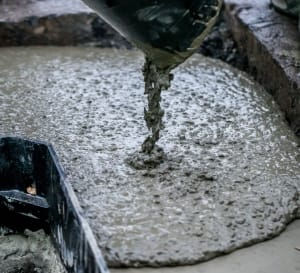
Concrete strength develops through a chemical reaction known as cement hydration, where water reacts with the cement compounds to form calcium silicate hydrate (C-S-H), the primary binding phase responsible for strength and structural integrity.
Chemically, full hydration of Portland cement requires a water-cement ratio of approximately 0.25. However, at this level the mixture would be far too stiff to place and consolidate properly. For practical construction applications, water-cement ratios typically range between 0.40 and 0.50, providing sufficient workability while maintaining structural performance.
Effect on Compressive Strength
The relationship between water-cement ratio and compressive strength is well established through Abrams’ Law, which states that:

For a given set of materials and curing conditions, concrete strength is inversely related to the water-cement ratio.
As excess water is added beyond what is required for hydration, it eventually evaporates during curing. This process leaves behind capillary pores within the hardened concrete matrix. These voids reduce density and weaken the internal structure of the material.
Typical relationships include:
Water-Cement Ratio | Typical Performance |
0.60+ | Lower strength, higher permeability |
0.50 | Standard residential and light commercial applications |
0.40–0.45 | Structural or high-performance concrete |
<0.40 | High-strength mixes requiring admixtures |
Impact on Durability and Permeability
The water-cement ratio also significantly affects concrete permeability, which directly impacts durability.
Lower ratios produce concrete that is:
Denser and less permeable
More resistant to freeze-thaw damage
Less susceptible to surface scaling and spalling
More resistant to chemical intrusion and reinforcement corrosion
For these reasons, many transportation and structural specifications—including those used in infrastructure and DOT work—place strict limits on maximum allowable water-cement ratios.
Workability and Admixtures
While lower water-cement ratios improve strength and durability, they also reduce workability. To address this, modern concrete mixes frequently incorporate water-reducing admixtures or high-range plasticizers.
These admixtures increase the fluidity of the mix without increasing the total water content, allowing the concrete to maintain a lower water-cement ratio while still being workable for placement and finishing.
Mix Control with Volumetric Concrete
At Site-Mix Concrete, maintaining the correct water-to-cement ratio is a critical component of quality control.
Our volumetric mixing systems proportion cement, aggregates, water, and admixtures in real time at the jobsite, allowing for:
Precise control of mix proportions
Consistent strength development
Fresh concrete produced exactly when needed
Reduced waste and improved mix accuracy
Because the concrete is mixed on site, adjustments can be made to maintain proper workability without compromising the designed water-cement ratio as these adjustments are usually made with plasticizers / water reducers.
Summary
The water-to-cement ratio is one of the most influential parameters in concrete mix design. Proper control of this ratio ensures that concrete achieves the intended compressive strength, durability, and long-term performance.
Through precise proportioning and on-site mixing, Site-Mix Concrete helps ensure every batch meets the technical requirements of the project while delivering fresh, high-quality concrete directly to the placement location.


